Evals for Agents That Act
An eval for a chatbot grades prose: was the answer correct, helpful, on-policy? You can run it offline, on a golden dataset, and read a number off the end.
An eval for an agent that acts is a different problem, because you’re not grading an answer — you’re deciding whether to let the thing touch production. The output isn’t a sentence; it’s a side-effect. And the question isn’t “is this good?” but “is this allowed to happen for real, yet?”
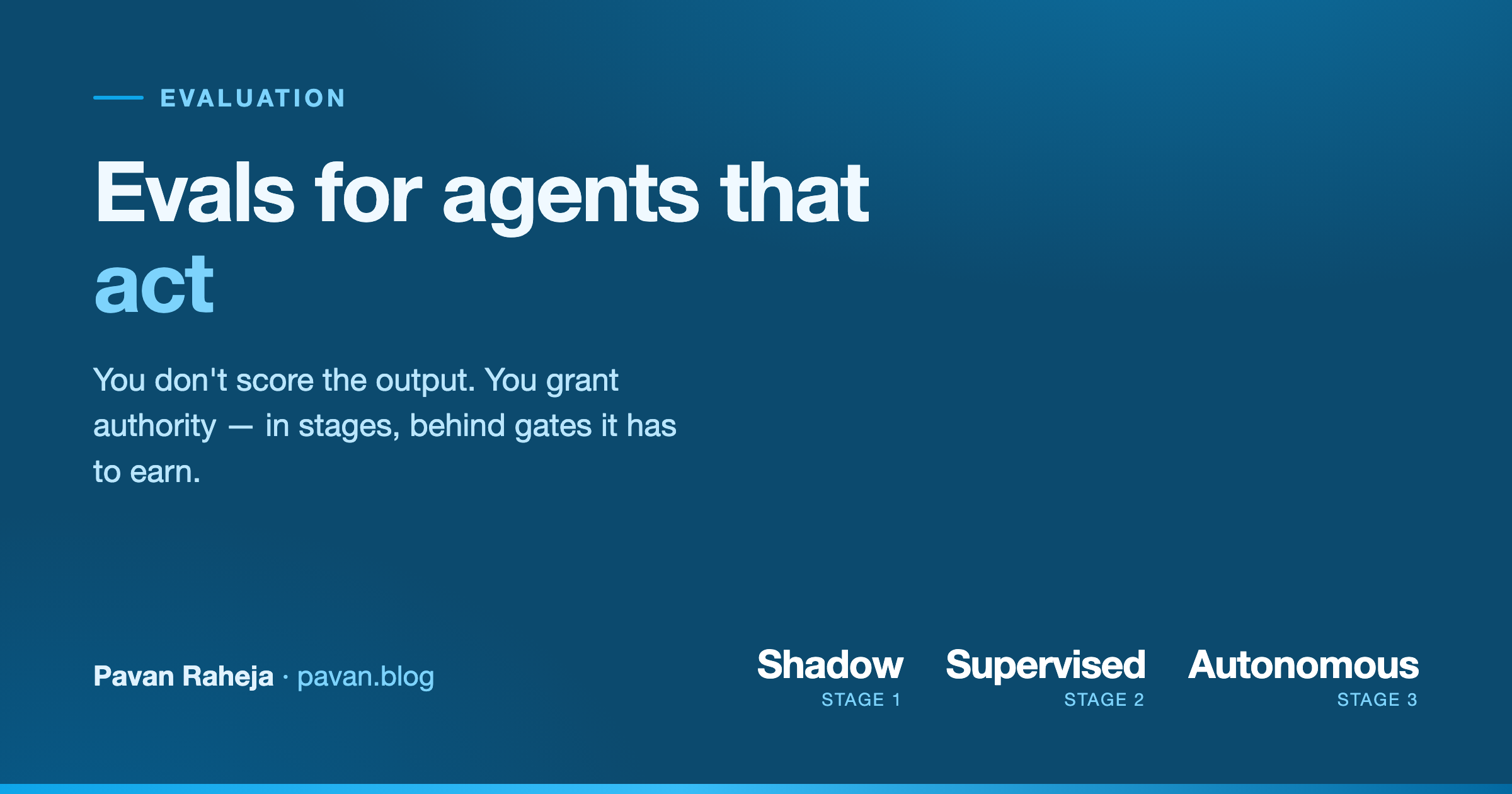
The shape that’s worked for me isn’t a score. It’s a ladder with gates. An agent earns the right to act by passing through stages, and each stage has an acceptance gate it has to clear before it’s promoted to the next.
The promotion ladder
   SHADOW              PAPER                LIVE (gated)
   logs decisions      runs the full loop   real actions, min size
   executes nothing    against a mock       Risk Guardian ON
        │                   │                    │
     ┌──┴──┐             ┌──┴──┐              ┌──┴──┐
     │GATE │             │GATE │              │GATE │
     │clears│            │behaves under│      │real metrics │
     │held- │            │realistic    │      │match paper  │
     │out?  │            │flow?        │      │within tol?  │
     └──┬──┘             └──┬──┘              └──┬──┘
        │ promote           │ promote            │ promote
        └─────────▶─────────┴─────────▶──────────┘
                    else: fix / kill
Shadow. The agent runs on real inputs, makes real decisions, logs all of them — and executes nothing. You compare its decisions against ground truth or against what a trusted process actually did. The gate: does it clear a defined threshold on held-out cases? Shadow is cheap and catches the embarrassing failures before they cost anything.
Paper. The agent runs the full loop — planning, tool calls, the works — against a mock adapter that simulates side-effects instead of committing them. This is where you find the integration bugs: the retry that storms, the loop that doesn’t terminate, the edge case the shadow inputs never hit. The gate: does it behave under a realistic flow, with metrics holding and no crashes?
Live, gated. Real actions, smallest possible size, with Risk Guardian on and the kill switch armed. The gate here is the one that actually matters: do the real-world metrics match what paper predicted, within tolerance?
Falsification, not confirmation
The trap in evaluating an agent is asking “does it pass?” — because you’ll find cases where it does and feel reassured. The more useful question is the scientist’s: what would prove this wrong?
So the gate at each stage isn’t a happy-path checklist; it’s a falsification battery — a suite of held-out, adversarial cases designed to break the agent. Stale data. Conflicting signals. The input that looks like the training distribution but isn’t. Promotion is blocked unless the agent survives the battery, not merely passes a demo. An agent that clears ten cherry-picked examples and dies on the eleventh adversarial one hasn’t earned anything.
Around the ladder runs a simple cadence: every batch of decisions gets a keep / fix / kill review on its real failures. Not a dashboard you glance at — a decision you make, on the cases that went wrong, on a schedule.
Why the last gate is always live
Here’s the part that the offline-eval mindset misses: the environment your agent was evaluated in is never the environment it runs in. I once had a strategy whose cost model was off by 266% — flawless in simulation, gone in production, entirely inside the gap between the two.
That’s why the final gate can never be a sandbox score. No matter how good shadow and paper look, the last promotion is always a small, real test, instrumented to compare live behavior against the paper prediction. The delta between them is the single most important number in the whole eval — it’s the measure of how much your simulation was lying to you.
The takeaway
Evals for agents that act aren’t a leaderboard. They’re a mechanism for granting authority incrementally: shadow earns the right to be taken seriously, paper earns the right to run the full loop, live-at-min-size earns the right to scale. You don’t grade the output and ship. You make the agent climb, and you put a gate on every rung — falsification on the way up, kill switch on the way down.
The number at the end of a chatbot eval tells you how good the answer was. The ladder tells you something more useful for anything that acts: how much you’re allowed to trust it, today.