How We Scaled Mashkor: A Product & Growth Story

Rarely do I share the details behind what actually happened at Mashkor. But enough people have asked that I figured it’s time to write it down properly.
Mashkor is a hyperlocal app in Kuwait. Two core services: “buy anything” and “pick up anything.” Users request drivers to purchase items or deliver from one location to another. Think of it as a personal concierge on your phone — powered by a fleet of drivers across Kuwait City.
When I joined, the business was flat. Around 250 orders per day. The goal was to scale it significantly — and fast.
Here’s exactly how we did it.
Who We Were Building For
Before touching any code or running any campaigns, we needed to understand who was actually using this product. Two personas emerged clearly:
The Kuwaiti Housewife — uses Mashkor as a modern replacement for a house driver. High frequency, high trust, very sticky once converted.
The Busy Working Professional — no time for outdoor errands. Uses the app for convenience. More transactional, but high volume.
These two personas shaped every decision that followed.
Phase 1 — Fix the Leaky Bucket First
Target: Scale from 250 to 1,000 orders/day within 18 months.
The instinct in most companies is to pour fuel on acquisition. We didn’t. Growth into a broken product just accelerates churn.
We ran qualitative interviews and quantitative surveys across two segments: first-time users (signed up but never ordered) and existing users (active but flagging).
What we found:
- New users: the value proposition was unclear on the homepage. Usability issues blocked conversion.
- Existing users: pickup times averaged 55 minutes. That’s the product failing, not the marketing.
Decision: Fix existing users first. Stop the bleed before you open the tap.
What We Built
Operations layer:
- Built dashboards and a prediction system to forecast order volumes by time and location
- Increased driver count, improved driver quality scoring based on customer feedback
- Target: reduce pickup times from 55 → 30 minutes
- Established OKRs around customer satisfaction — not just orders
- Proactive delay communication + partial refunds for significant delays
Product revamp — every step of the journey:
| Touchpoint | Change |
|---|---|
| Onboarding | Visual education of what the app can do |
| Sign-up | Added WhatsApp + Google sign-on, OTP via WhatsApp |
| Homepage | Google Maps search bar for easier place discovery |
| Order page | Improved address accuracy (learned from local players) |
| Cart | Contextual prompts to guide users |
| Checkout | Integrated Apple Pay |
| Re-order | Added one-tap reorder directly from homepage |
Results after Phase 1:
- Pickup times reduced to 30 minutes within 2 months
- Conversion rate: 19% → 32% in ~5 months
- App ratings and satisfaction scores improved significantly
Phase 2 — Grow the Top of Funnel
With the product stable, we turned to acquisition.
Attribution + Analytics First
We implemented Adjust and MoEngage before spending heavily on paid channels. You can’t scale what you can’t measure. Attribution had to be airtight.
Channel Experimentation
We tested everything: Google, TikTok, Instagram, Apple Search Ads.
Findings:
- Google and TikTok → clear attribution, reliable CAC data → doubled down
- Apple and Instagram → partial traction → increased by 30% and kept optimising
- Social content (contests, memes) → drove link clicks and converted surprisingly well
- Word of mouth → maintaining strict SLAs created genuine delight → customers spread it
Hypothesis-Driven Growth at Every Touchpoint
We ran experiments across the entire funnel — not just top-of-funnel ads:
- Onboarding: Multiple flows tested to educate users effectively on first open
- Sign-up: Reduced friction, tested every method, optimised for completion rate
- Non-transactional users: Targeted campaigns for users who signed up but never ordered
- WAU (Weekly Active Users): Personalised offers based on time of day, busy vs quiet days, trending locations
- Churned users — voluntary: Personalised re-engagement with offers + surveys to understand the why
- Churned users — involuntary: Fixed technical failures (crashes, payment issues) + improved support response times
Results after Phase 2:
- User base grew 2.5× in a short window
- Continued scaling investment into the top-performing channels
Phase 3 — AI/ML to Deepen Engagement
With users growing, the next lever was basket size and engagement depth.
Objective: Increase basket size by 20% through personalisation.
User Segmentation
We split users into three tiers:
- Casual — 1 order
- Core — 2 to 4 orders
- Power — 5+ orders
We studied power user behaviour obsessively. What did they order? When? Which categories? What made them come back?
What We Built
- Built a categories section based on power user insights
- Implemented Google Vertex AI for personalised recommendations
- Focused on habit-forming, popular places — served at the right moment in the session
- Batch recommendations first, moving toward real-time as data matured
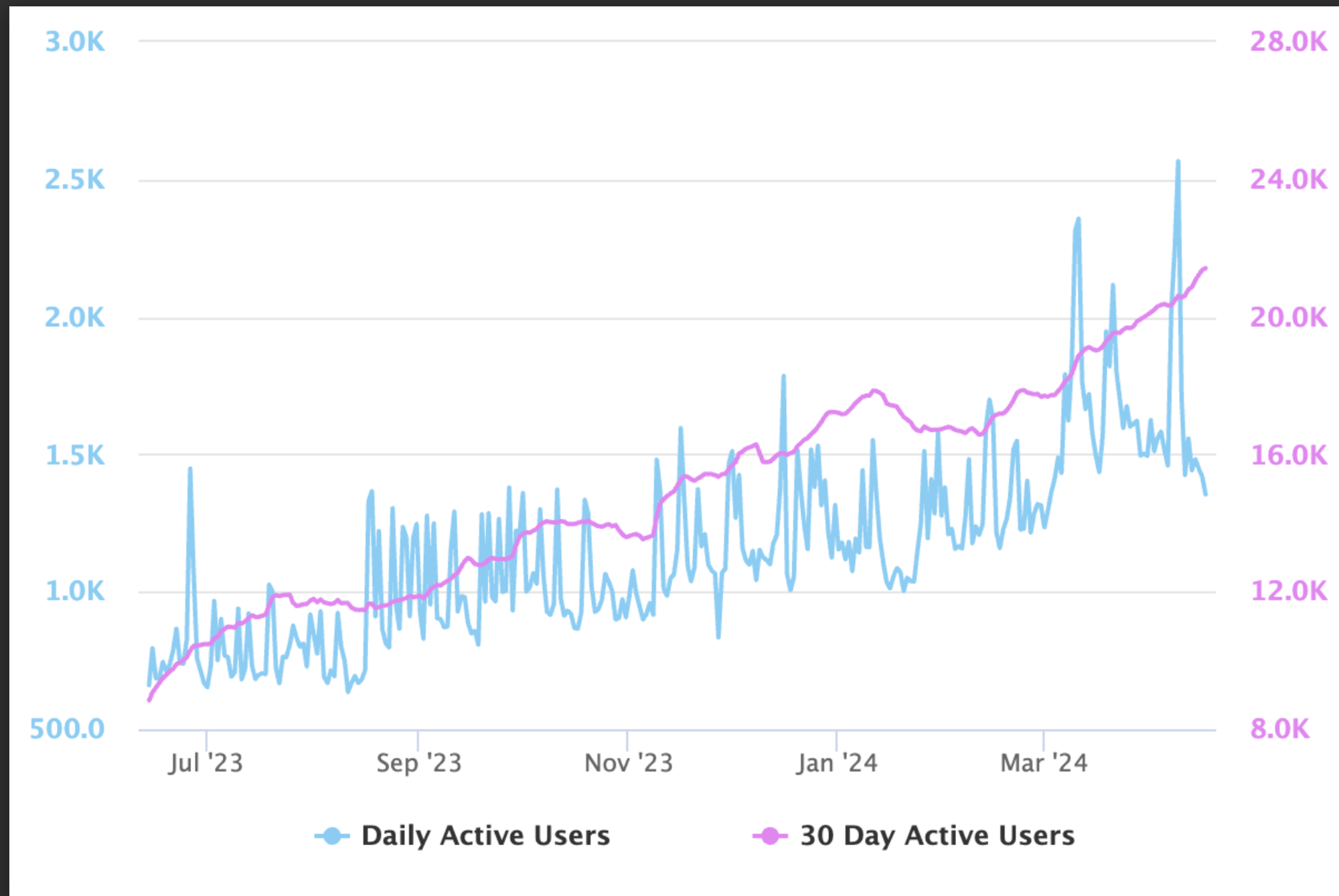
The chart shows what compounding looks like in practice. 30-day active users (pink) grew steadily and consistently. Daily active users (blue) followed the trend upward with clear acceleration from Jan 2024 onward.
Results:
- CTRs increased significantly from personalised recommendations
- Average basket size improved by 7%
- Overall engagement up 15% within 50 days
- User count reached 3.5×
- Revenue reached 2.8×
The Team Behind It
None of this happens alone. I led a product team of 2 PMs and 1 designer. Engineering was 1 EM and 10 engineers. We worked tightly with marketing, legal, finance, and sales — alignment across functions is what made the execution clean.
What I’d Take From This
A few things I’d tell anyone scaling a consumer app:
→ Fix before you grow. Pouring acquisition budget into a broken product is expensive in every sense. Conversion rate improvements compound faster than any paid channel.
→ Attribution before spend. We ran the analytics setup before the campaigns. Most teams do it the other way and waste months of data.
→ Segment your users — then study the best ones. Power users are your product manual. They’re already doing what you want everyone to do. Understand them deeply.
→ AI/ML isn’t magic — it’s iteration. Vertex AI didn’t work on day one. Batch recommendations came first. Real-time came later. The technology serves the hypothesis, not the other way around.
→ SLAs are a growth lever. Reducing pickup times from 55 to 30 minutes drove word-of-mouth we couldn’t have bought. Operational excellence is a marketing strategy.
The 18-month journey from 250 orders/day to 3.5× users and 2.8× revenue wasn’t one big move — it was a hundred small ones executed in the right sequence.
That’s the game.